Keep useful moves available while making your opponent's choices harder. Secure corners when you can, be careful near empty corners and avoid judging an early position by disc count alone. These are practical heuristics, not a guaranteed winning formula.
A corner is a disc that stays yours.
The four corners, A1, H1, A8 and H8, cannot be outflanked. Once you own a corner, that disc cannot be flipped for the rest of the game. A corner can also support a run of secure discs along an edge.
Check whether a corner is available before choosing another move. Also check whether your move gives a corner to your opponent on the very next turn. A large flip in the center may be a poor trade if it gives away a corner and the stable edge discs that can follow.
Be careful next to an empty corner.
The diagonal neighbors of corners are often called X-squares: B2, G2, B7 and G7. The edge squares immediately next to a corner are often called C-squares. Playing these squares can give your opponent a route into the corner.
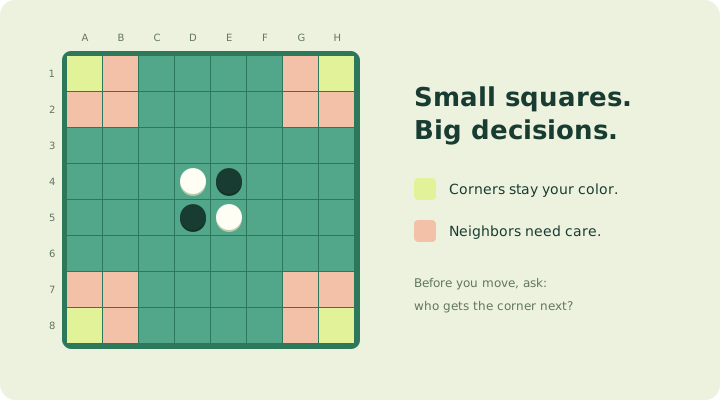
This is a caution, rather than a permanent ban. Once a corner is already occupied, its neighboring squares have a different role. Some advanced positions also justify playing near an empty corner. As a beginner, ask what corner access your opponent gains before making that move.
Count choices, not just discs.
Mobility means the legal moves available to a player. Having several useful options lets you choose a move that keeps the position comfortable. If your opponent has only awkward moves, they may be forced to give you a corner or another favorable position.
Before placing a disc, imagine your opponent's next turn. Which legal moves will they have? Does one of them immediately take a corner? Can you make a quieter placement that leaves them fewer safe choices? There is no need to calculate the entire game to start asking these questions.
Notice the discs next to empty space.
A frontier disc touches at least one empty square. Large exposed groups can create extra moves for the opponent. Taking many discs early can leave you with a broad frontier and few good moves later.
This helps explain why the current score can mislead. A modest flip that keeps your discs compact may be more useful than an impressive flip across the board. It does not mean you should always minimize your discs: position and available moves still matter.
Change your thinking as the board fills.
The objective is still to finish with more discs. As empty squares run out, count actual lines and possible replies more carefully. With a few empty squares left, it is often possible to compare complete sequences rather than rely only on general rules.
Parity concerns who makes the last move in an area or in the game. Passes and separate empty regions make it more subtle than simply counting empty squares as odd or even. Start by following the next two moves accurately, then extend the sequence as your confidence grows.
Give each game one small purpose.
- First game: notice all four corners before every move.
- Next game: pause before entering an X-square next to an empty corner.
- Another game: compare your opponent's available replies.
- At the finish: use Undo to revisit one decision and try a different line.
Our computer opponent offers three practice levels. The browser AI uses limited search and board evaluation; it is a practice partner, not a perfect solver. If legal moves still feel confusing, return to the illustrated rules first.